The lost foam casting process gives foundries a way to produce complex shapes with an expendable foam pattern that remains in the mould during pouring. That simple description hides a tightly connected production system: pattern quality, coating, dry sand handling, vibration, metal delivery, fume control, and sand recovery all affect the final result. Buyers planning a new line should therefore evaluate the process as a sequence of controlled handoffs, not as a collection of stand-alone machines. This guide outlines what engineering and purchasing teams should clarify before specifying equipment.
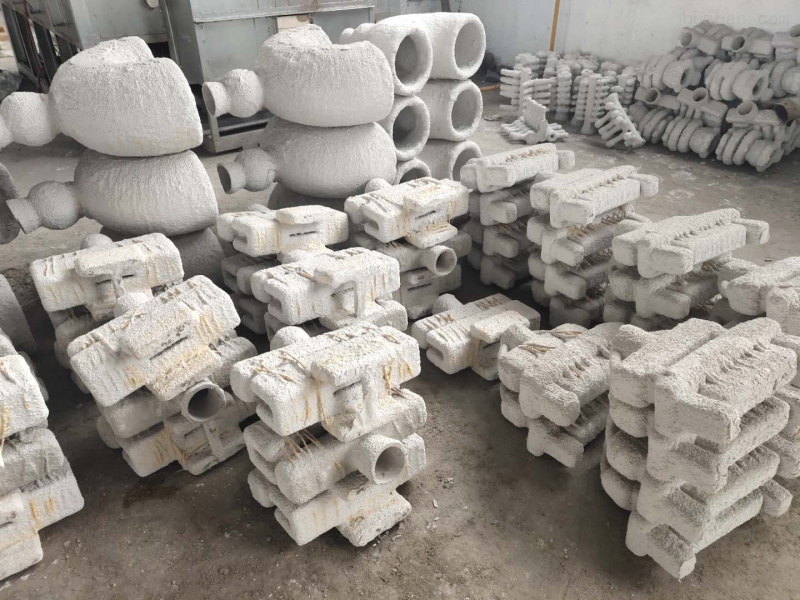
Understand the production sequence
In lost foam casting, a foam pattern and gating arrangement are prepared, coated with a refractory layer, dried, placed in a flask, surrounded with unbonded sand, compacted by vibration, and then poured. The foam is displaced as metal fills the cavity. After solidification, the casting is separated from sand and sent to finishing while the sand is reclaimed.
Each stage has an interface to define. A line concept should show how patterns arrive, where coated clusters dry, how flasks are filled and transported, and how castings and sand leave the process. A layout drawing makes capacity discussions more useful than a list of isolated equipment names.
Define the foam pattern and cluster requirements
Pattern density, dimensional stability, joint quality, and gating design influence filling behaviour and casting finish. Procurement teams should document the range of part sizes, annual mix, cluster size, and changeover expectations. These inputs guide choices for pattern moulding, assembly stations, handling fixtures, and inspection methods.
Ask who owns the tooling and how pattern revisions will be controlled. If several products share a line, the equipment should allow repeatable positioning without relying on undocumented operator adjustments. This is a key conversation when evaluating a lost foam casting production line.
Match coating and drying to the casting mix
The refractory coating supports surface quality and gas management, so its application and drying deserve explicit acceptance criteria. Define the coating preparation method, application approach, drainage time, drying capacity, and how the team confirms that a cluster is ready for moulding. The right settings depend on alloy, section thickness, pattern geometry, and production rhythm.
Drying capacity should be considered with normal work-in-process, not just one cluster. A bottleneck in this area can push operators to pour insufficiently prepared patterns, which makes a stable procedure more valuable than an optimistic throughput claim.
Control unbonded sand and compaction
Dry, clean sand must support the coated pattern uniformly. Equipment planning should include sand cooling, screening, storage, delivery to the flask, vibration control, and dust collection. Confirm how the line maintains consistent sand condition during start-up, steady production, and recovery after an interruption.
Vibration settings should be documented for representative product families and verified with trial castings. Excessive or inconsistent compaction can damage a pattern or leave weak support in complex areas. A supplier should explain the adjustment range and the records operators can use to keep the process repeatable.
Coordinate pouring and gas handling
Pouring must be coordinated with flask arrival, metal temperature practice, and the capacity of the fume-extraction system. Rather than quoting generic cycle times, ask for the proposed sequence of metal delivery, pour control, cooling time, and safe access for the crew. The answer should fit the alloy and casting geometry planned for the line.
Fume capture should be considered at the layout stage because hoods, duct routing, and access clearance affect both safety and maintainability. For broader project planning, our foundry equipment services can help frame the interfaces between process equipment and site utilities.
Plan sand reclamation and finishing
Sand recovery is part of the production system, not a downstream afterthought. Specify the desired recovery path, cooling needs, screening points, dust handling, and the storage capacity needed to avoid starving moulding or overfilling the shakeout area. Establish clear inspection points for reclaimed sand before it returns to the process.
Also map casting handling after shakeout: cooling, gate removal, cleaning, inspection, and movement to the next operation. A line that has balanced moulding capacity but limited finishing space can still create avoidable queues and handling risk.
Use trials to set the production baseline
Before final acceptance, run representative patterns through the whole sequence and document the conditions used. Record coating preparation, drying confirmation, sand condition, vibration settings, pouring practice, cooling time, and the observations from cleaning and inspection. The goal is a repeatable starting point for the production team, not a one-time demonstration under exceptional conditions.
Include the operators and maintenance staff in these trials. Their feedback can identify access problems, cleaning points, changeover steps, and service tasks that are difficult to see in a layout review. A documented baseline also makes later capacity or product-mix changes easier to evaluate.
Build an RFQ around measurable decisions
- What casting families, alloy range, part dimensions, and annual mix will the line support?
- How will pattern, coating, drying, sand, pouring, and finishing capacity be balanced?
- Which utility loads, environmental controls, and operator stations are included?
- What trials, documentation, and training will demonstrate the agreed scope?
- Which spare parts and maintenance tasks are needed for a sustainable start-up?
A clear RFQ helps compare suppliers on process fit rather than headline capacity alone. If you are assessing a new line or a staged upgrade, review our foundry equipment FAQs and contact us about your project with the casting mix, site constraints, and desired production flow.